InsureComp
A workers’ compensation rating engine and automation platform built for InsurePro 2.0 — requiring our team to develop deep expertise in US insurance calculations, state-specific rating rules, and the document workflows that underpin the industry.
InsurePro 2.0, founded in 2010, is a specialist BPO serving the US insurance industry — providing offshore underwriting and operations services to carriers, brokerages, Managing General Agents (MGAs), and Professional Employer Organisations (PEOs). Over a nearly four-year engagement, we built the InsureComp platform from the ground up: a workers’ compensation rating engine that evolved from an internal quoting tool into a multi-tenant system used by other insurance intermediaries, alongside a suite of automation capabilities that significantly reduced the manual effort behind core insurance workflows.
A rating engine and automation platform built on hard-won insurance domain knowledge
-
Workers’ Compensation Rating Engine
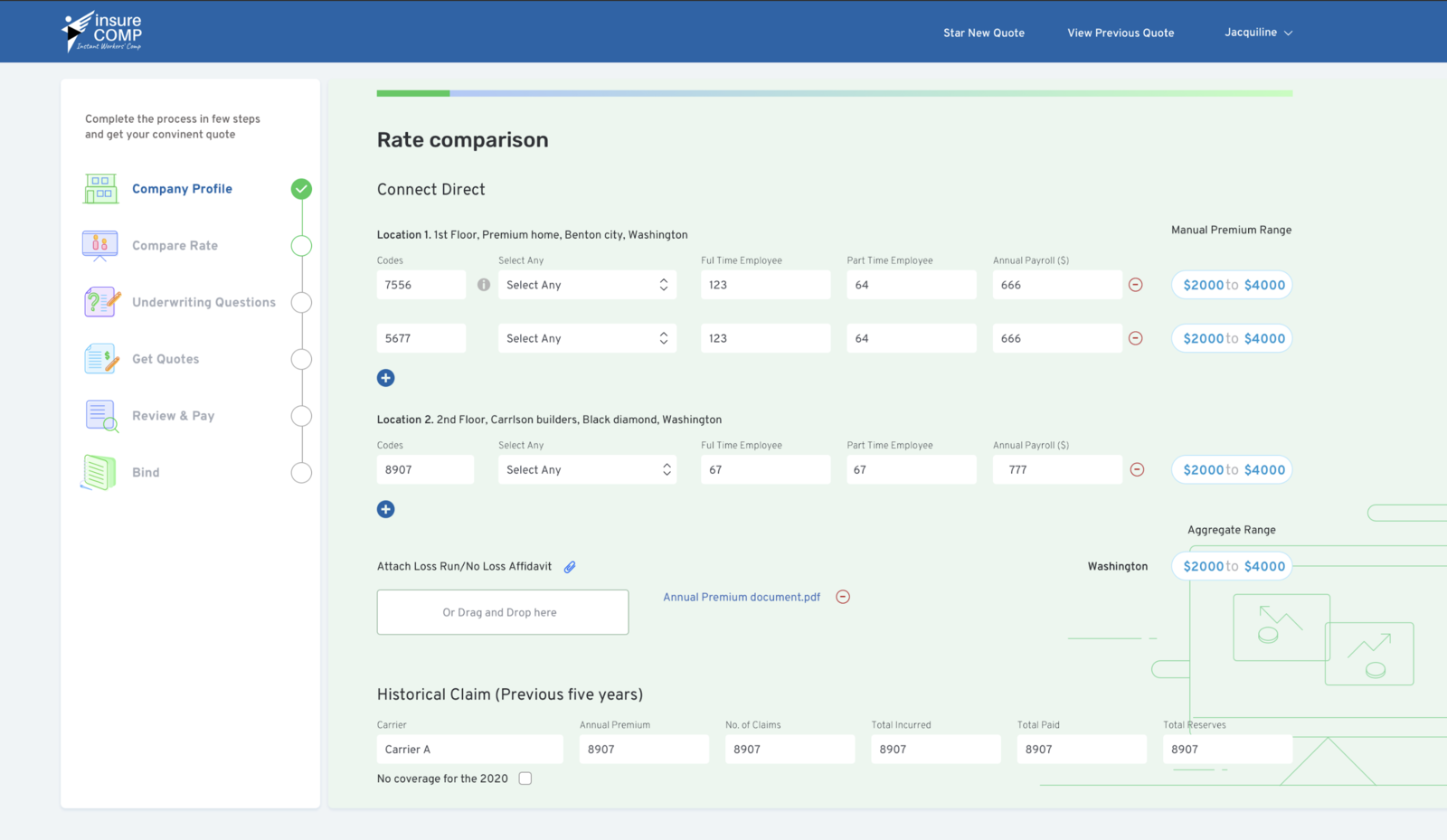
The core of the InsureComp platform is a rating engine that takes the inputs found on ACORD forms — business details, locations, employee headcount broken down by job classification — and produces workers’ compensation classification codes and premium estimates. The complexity lies in the rating rules: each US state has its own set of rules, rate tables, and modifiers, and the engine had to handle this variation correctly across all relevant states. What began as an internal quoting tool for InsurePro 2.0 evolved into a multi-tenant platform, with other carriers, MGAs, and brokerages using the engine as the basis for their own quoting workflows.
-
ACORD Form Processing with OCR
ACORD forms — the standardised application documents used across the US insurance industry — typically arrive as scanned PDFs or paper submissions. We built an automated processing pipeline using AWS Textract, extracting the structured data fields from these forms and routing them into the InsureComp platform without manual re-entry. At the time of development, Textract represented the best available OCR capability for this class of document, and we built the extraction and validation logic around its output to achieve reliable results on real-world form submissions.
-
Loss Run Processing & Automation
Loss runs — the historical claims records that insurers request before writing a workers’ comp policy — come in a wide variety of formats from different carriers. We built an OCR-driven processing pipeline that could extract loss history data from these varied documents, normalise it, and ingest it into the platform. Automating this step removed one of the most time-consuming manual tasks in the underwriting workflow, allowing the InsurePro 2.0 team to process a significantly higher volume of submissions without proportionally growing their operations headcount.
-
Insurance Domain Expertise
Workers’ compensation insurance is a technically demanding domain. Our engineers did not treat it as a black box to be configured — they studied the underlying calculations: how classification codes are determined, how experience modification factors work, how state-specific rate tables are applied, and how the various inputs on an ACORD form translate into a quoted premium. This depth of domain knowledge was what made it possible to build a rating engine that was accurate enough to be trusted by insurance professionals. It also reflects something we value in how we engage with clients in specialised fields: we do the work to understand the domain, not just the software.
-
AWS Serverless Architecture & React Frontend
The platform was built on a Django backend with a serverless AWS stack handling the processing-intensive workloads — including the OCR pipelines and document processing jobs that needed to scale independently of the core application. The frontend was built in React, providing underwriters and operations staff with a structured interface for reviewing extracted data, managing submissions, and running quotes. The architecture was designed with the assumption that processing volumes would grow significantly as the platform was adopted by additional intermediaries.
-
In-House Team Development & Handover
Over the course of the engagement, we worked closely with InsurePro 2.0 to help them build an internal engineering capability around the InsureComp platform. This was a deliberate and phased process — transferring not just the codebase, but the domain knowledge, architectural decisions, and operational practices that had accumulated over nearly four years of development. By the time the engagement concluded, InsureComp had an in-house team equipped to carry the platform forward independently. Supporting that transition successfully is something we take as seriously as the engineering work itself.
Building in a regulated or specialised domain?
We invest in understanding the domain — not just the software. If your product requires deep subject matter knowledge to build correctly, that’s where we do our best work.
Start a conversation