Redseer Strategy Consultants
A multi-year technology partnership with one of India’s most prominent strategy consultancies — from emergency security remediation to a modern headless CMS stack, built with a consistent focus on automating the work that others do manually.
Redseer Strategy Consultants, founded in 2009 and headquartered in Bengaluru, is one of India’s most widely cited strategy firms — the most quoted consulting firm in the Indian media, with a 90%+ market share of new-age IPOs including Zomato, Nykaa, Paytm, and GoTo. With 200+ consultants across seven offices in India, the Middle East, Southeast Asia, the United States, and the United Kingdom, Redseer publishes extensively across sectors ranging from quick commerce and e-commerce to digital media and financial services. They came to us in 2022 to take over the maintenance of their WordPress site — and what began as a support engagement became a long-term technology partnership.
Three years of partnership, from security remediation to a modern headless stack
-
Security Audit & Malware Removal
The engagement opened with an urgent mandate: the existing WordPress site had active security issues and malware that needed to be resolved before anything else could proceed. We conducted a thorough audit, identified and removed the malware, closed the attack vectors, and stabilised the site. With the platform secure, we could turn our attention to the longer-term work ahead.
-
Custom WordPress Theme & Elementor Plugins
We redesigned the site to match Redseer’s updated brand guidelines — building a custom theme from scratch rather than adapting an existing one. Where standard Elementor widgets did not cover the required functionality, we developed custom Elementor plugins to fill the gaps, ensuring the design could be realised fully without compromises. Redseer’s site carries a significant body of existing content — reports, case studies, and news articles — so the redesign was done with careful attention to backward compatibility. We also cleaned up years of inline styles across that content to ensure it rendered correctly within the new theme without visual inconsistencies.
-
Figma-to-Elementor Automation for Industry Pages
Around 40 industry-specific pages were designed for the site — pages that needed to be built in Elementor while the Next.js transition was underway in parallel. Rather than build each page by hand, our team studied the underlying data structures that Elementor uses to store page layouts and wrote scripts to convert Figma designs directly into Elementor-compatible data. This reduced the effort to a fifth of what manual construction would have required. We often find that understanding a tool at the data layer — rather than just its interface — opens up approaches that conventional agencies simply do not consider. This was one of those cases.
-
Headless WordPress & Next.js Migration
In 2025, we began migrating the site to a headless architecture — with WordPress retained as the content management system and Next.js serving the frontend. This iteration also brought a revised design language and a rethought approach to key pages, informed by three years of working with the site and observing how it was used. The editorial team continues to manage articles and newsletters through the WordPress editor, preserving a familiar authoring experience while the delivery layer is entirely new.
-
Elementor-to-Next.js Conversion Pipeline
Once the Next.js frontend was ready to receive them, the 40 industry-specific pages built in Elementor needed to be converted. Rather than rewriting each page manually, we built a conversion pipeline that parsed the Elementor data storage format and generated the corresponding Next.js components. This is a pattern we apply deliberately and repeatedly: when we understand how a tool stores its data internally, we can build the tooling to transform it at scale — and do in hours what would otherwise take weeks. It is one of the ways our team works significantly faster than agencies that treat these tools as black boxes.
-
Search Integration
Given the volume of reports, newsletters, and articles that Redseer publishes, search is a primary navigation mechanism on the site. We integrated a dedicated search solution — delivering a fast, relevant, and filterable search experience across the full content catalogue. The new search replaced what had previously been a slow and imprecise WordPress default, meaningfully improving how visitors find content.
-
Custom Gutenberg Blocks
To allow the Redseer team to add structured, dynamic sections within their articles and newsletters — without stepping outside the WordPress editor — we developed custom Gutenberg blocks tailored to their content formats. This required a deep understanding of how WordPress stores block data and how that data flows through to the frontend. The result is an editorial experience that feels native to WordPress, while producing output that the Next.js frontend can render with full fidelity. Our depth with WordPress internals is what makes this possible — and it is what allows us to extend the platform in ways that go well beyond what most agencies can offer.
-
PostHog Analytics Integration
We integrated PostHog across the site to give the Redseer team granular visibility into how visitors engage with specific sections and content types. Rather than relying solely on aggregate page metrics, the team can now track interaction patterns at a component level — understanding which report categories attract the most engagement, how far readers progress through long-form content, and where drop-off occurs. These insights feed directly into decisions about content structure and page layout.
-
HubSpot CRM Integration
We built an extensive HubSpot integration that connects the website’s key conversion points directly to Redseer’s CRM. Form signups and report downloads are pushed to HubSpot via API in real time, ensuring every lead interaction on the site is captured and attributed accurately. This closes the loop between the content Redseer publishes — which drives significant inbound interest — and the commercial pipeline that follows from it.
-
AI-Assisted Content Operations
For certain structured sections of the site, we use Claude-powered scripts to update content — validating data against live web sources before writing changes directly to WordPress via WP-CLI. This is the kind of operational pattern that becomes possible when a team is comfortable working at the intersection of AI tooling and platform internals: what would otherwise be a repetitive, error-prone manual process becomes a validated, auditable pipeline. It reflects something broader about how we approach operational work — we look for the layer where tooling can replace effort, and we build for it.
-
Interactive, Code-Based Report Pages
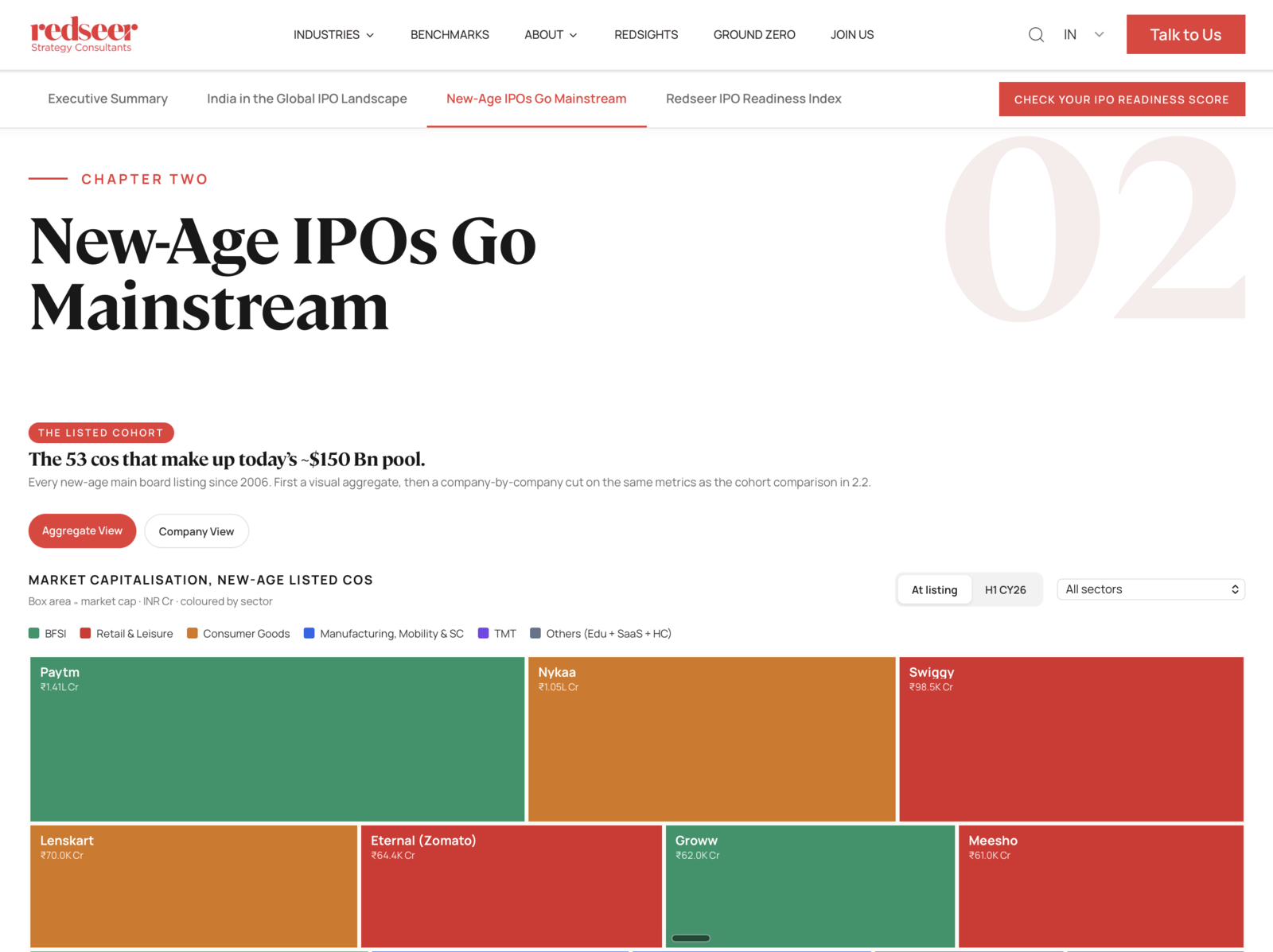
Beyond structured articles, Redseer publishes long-form research reports that benefit from rich interactivity — data visualisations, embedded charts, and custom layouts built to fit a specific report’s argument. We extended the platform so the team can author these as code-based pages — increasingly assisted by AI — that the Next.js frontend renders with full fidelity, without engineering needing to hand-build every report.
Working with WordPress at scale?
Whether it’s a migration, a performance problem, or a complex build — our depth with WordPress internals means we can do things faster and more precisely than agencies treating it as a black box.
Start a conversation